Tuesday, May 28, 2013

From Miners to Fossil Hunters


We took a day-trip out to Cripple Creek, an old gold-mining district to tour the Molly Kathleen Mine and following that we went to the Florissant Fossil Beds National Monument.

Molly Kathleen was the first woman to stake a claim in the gold mining district.  She was quite the entrepreneur -- since women weren't allowed to stake claims the claim was filed under her initials by her husband.  Once the entrance to the mine was opened, she allowed adjoining mines to be accessed through her entrance, charging an entrance fee. 


Before the tour we donned miner's jackets and hard hats.  Then we were squeezed into two elevators -- nine people into each 3-foot section of the double-cage.  We got to know each other very well as we descended 1000 feet to the base of the mine.
 
 
The mine was well-lit and wasn't as claustrophobic as we had anticipated.


The tour guide was excellent -- explaining how the mining procedures worked and how they evolved from everything being done by hand through the invention of machines to help in the mining process. 

We next stopped at the Cripple Creek Heritage center for a look at some interesting exhibits.  Then we drove  into the valley, which is an ancient caldera,

 
through the town but didn't stop, as it seemed to be door after door of casinos and bars.  With nothing of interest to us, we continued on to the Florissant Fossil Beds National Monument.  This giant area contains fossilized giant redwood tree stumps and the world's largest collection of insect fossils.

Another geology teaching:  Giant redwoods grew in a valley in Colorado 26 million  years ago.  A volcano filled the valley with mud and ash and covered the trees to a depth of about 16 feet and so the trees died off.   The debris from the volcano dammed an existing creek, filling the valley with water, creating a new lake.  For the next 100,000 years insects and plants settled in the sediments of the lake.  Later volcanic activity covered the lake and its sediments with more mud and ash.  During all this time, mud and water entered every cell of the buried redwood stumps, insects and plants, preserving them as fossils.   

Now the entire area is preserved as a National Monument.  We toured a brand new visitor center, looked at the exhibits and fossilized insects and plants, and walked on a trail through the fossil beds to see the giant redwood tree stump fossils. 

And then we headed back to Colorado Springs on yet another scenic road.


For more pictures of our outing to Cripple Creek and the Florissant Fossil Beds, including more fabulous scenery, click Miners and Fossils

Monday, May 27, 2013

Colorado means Colored Red

From the Garden of the Gods

 
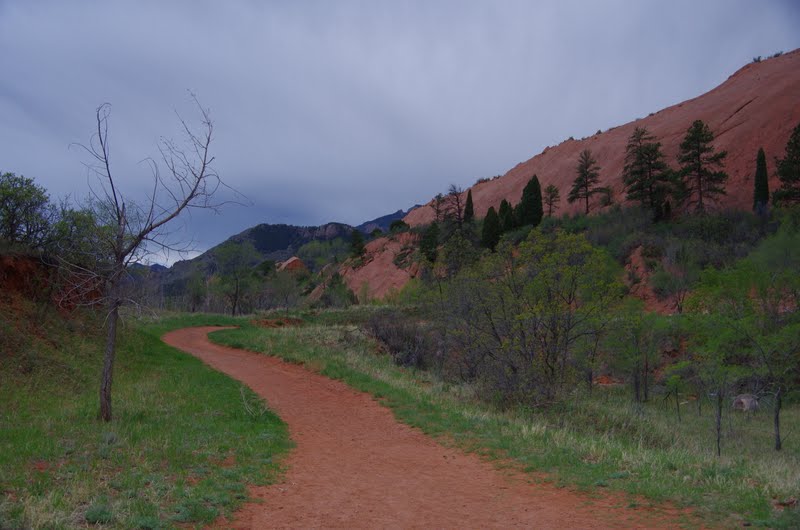
 to the Red Rock Canyon
 
to the red cliffs around the Manitou Cliff dwellings, 

we kept looking in awe at the amazing red rocks. 
Where did they come from?  
A little geology lesson for those that are interested:
The red rocks of Colorado are sediment left from the ancestral Rocky Mountains. (Did you know there were Rocky Mountains about 320 million years ago, before the current Rocky Mountains?) This first set of Rockies  eroded and left red sand which was then covered by an shallow ocean for millions of years.  Slowly, the red sand turned to stone because of the pressure of the ocean and ocean sediments. Due to plate tectonics the second set of Rocky Mountains arose out of the ocean about 35 million years ago, and when this happened the red rocks were lifted from their horizontal position and tilted at strange angles.   Erosion of the modern Rockies helps to exaggerate the angles of the rocks and expose other sedimentary rocks that are various colors.  More on this in future blogs.

We don't have enough words to describe the beauty of nature that we've been seeing since we arrived in the southwestern Colorado Springs area.  Impressive, amazing, overwhelming, rugged, colorful … hopefully our pictures will help, although even great photos don't do it justice. 

To see more of the red rocks in the Colorado Springs area, click Garden of the Gods and Red Rock Canyon and Manitou Cliff Dwellings

Saturday, May 25, 2013

Seven Falls

When the Ice Skating Hall of Fame was closed for the second time,


we decided to check out Seven Falls, a commercial endeavor in a beautiful canyon where we could see one waterfall and maybe hike to see six more. 


Perhaps because of the recent drought here, the waterfalls were unimpressive. 


But the canyon was gorgeous.  For Jim who's interest in geology keeps growing and Sherry, who loves looking at rock formations, it was yet another amazing experience.


After watching a 10 minute Indian dance performance (the young Indians were very talented)


we decided to climb the stairs beside the waterfall -- 240 steps starting at an altitude of over 6300 feet! 


The air is very thin up here and that makes breathing difficult, especially when you're used to an altitude of 20 feet!  Along with dozens of other folks out celebrating the holiday weekend, we began the climb. 

I was quite dizzy every time I looked down, but I did manage to steel a few peeks at the waterfall, the surrounding rocks, and the view from the top.


Breathlessly, and weak-kneed, I made it to the top of the stairs. Once at the top we rested at a shelter, had a snack and some water, and continued, on level ground. 


After about 30 minutes we came to a small waterfall.


We took some pictures and chatted with a couple from Adelaide, AU, who are travelling through the US.  (Jim was wearing an Australia T shirt, so they wondered if we were their countryfolk. ) 

Jim tried to take some pictures of a butterfly, and he succeeded,


but not until after the butterfly parked for awhile on his hat!


We headed back to those incredible stairs, made it down safely,
stopped at the café for a well-deserved lemonade, and watched some kids trying to feed the chipmunks that hang out near the café. 


Then we walked through a cave in a mountain to an elevator (yes a real elevator) that took us up to a viewing platform where we had a great view of  main waterfall.

It was a wonderful and very tiring day. 

For more pictures of our day at Seven Falls,
click Seven Falls.


Wednesday, May 22, 2013

Cog to the Top

We've been viewing snow capped Pike's Peak from all over Colorado Springs.  (If you've seen our earlier blog posts you've seen some of our views.)  Pike's Peak is one of 54 Colorado peaks that are over 14000, and it is certainly not the tallest.  It is the eastern most peak, and since it's not surrounded by other "fourteeners" it is very visible for great distances.  

On Wednesday we rode a cog railway to the top of Pike's Peak.  

A cog railway climbs steep grades by using a gear-like wheel to engage teeth in a center rail.  The technology was designed in Switzerland and the first cog railway ever built was the one that goes up Mt. Washington in New Hampshire.  But the Manitou and Pike's Peak Railway is the highest.  
 

We were fortunate to have a beautiful clear day.  It was in the 70's at the bottom but we came prepared for the 30 degrees and snow at the top.


The ride up the mountain was one and a half hours, and we passed through some beautiful scenery and enjoyed the running commentary from the conductor.


At the top of Pike's Peak, we were at an altitude of:


we had some spectacular views


and then we sampled the


-- something we don't ordinarily eat but we had to give them a try.  Yummm.  They are light and airy because they are baked at such a high attitude. 


After about a half-hour we boarded the train for the return trip. 

As the train descended the mountain we passed a number of different terrains.  We were lucky enough to see a Colorado bighorn sheep

and had some more incredible views.

For more pictures of the trip to the peak of Pike's Peak, see Pike's Peak.


Tuesday, May 21, 2013

Colorado Springs


After the RVSEF conference ended we travelled about 30 minutes from NE Colorado Springs to SW Colorado Springs and the Garden of the Gods campground.  At first we were a little put off because it was a tight fit, but it was clean and neat, fairly empty and quiet, and in a great location --

between the historic mountain town of Manitou Springs with its shops and restaurants and interesting architecture


and historic Colorado City with more shops and restaurants and interesting architecture. 


Nearby were the scenic natural wonders that we seek and enjoy  -- North Cheyenne Canyon, 


  Garden of the Gods,
 
 
Red Rock Canyon,
 

Seven Falls,


and although not entirely natural, the historic cliff dwellings of the Anasazi (the ancient ones) Indians.


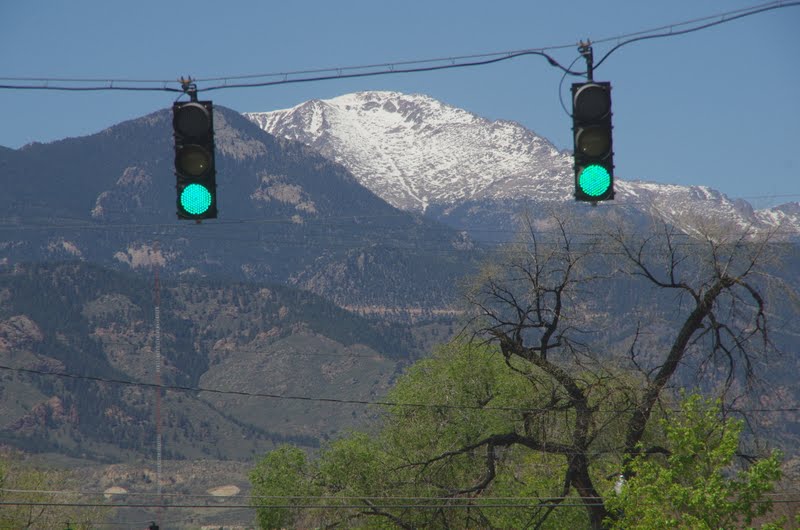
 The views of Pike's Peak were everywhere


and the hilly terrain didn't make us miss NJ at all!


After four days at the Garden of the Gods campground we moved to Golden Eagle Ranch campground, where we were fortunate enough to get a reservation on short notice for Memorial Day weekend.  The Ranch is a huge campground with about 500 sites, high in the hills and surrounded by mountains, but only 20 minutes from the main attractions of the Manitou Springs area.   We arrived on Thursday so it was pretty empty and we chose a large site with a great view. 

By the weekend it was much more crowded but many of the neighboring sites were still unoccupied.  We continued to explore the area, and also took some time to take care of life's necessities like grocery shopping and laundry. 


In future posts I'll share some more of our Colorado Springs adventures.  Tune in later.

Sunday, May 19, 2013

RV Safety and Education Conference


The RVSEF conference was held May 14th through the 18th.  We attended classes on maintenance, finding campsites, road safety, fire safety, smart phones, and cloud programming, to name a few, and learned from experts in the RVing field and people who have been full-timing for many years.  We met up with some old acquaintances and made some new friends.  And, for the first time we presented our Newbies to Newbies class-- designed to show people what fun learning and RVing can be, and provide some tips we've learned along the way.  The conference was small -- less than 30 attendees, and we were afraid no one would come to our class, as there were four sessions at a time.  But we had a full room and everyone in the class found our information and stories interesting and helpful.

While the number of people at the conference was small, we met in a mega-church in Colorado Springs.  Classes were held in 4 small classrooms, and those of us with RVs parked in the giant parking lot, where we had a wonderful view of Pikes Peak.  This was our third RVSEF conference and it was still a great experience.
 

Saturday, May 18, 2013

Pikes Peak Everywhere

From the first sight of Pikes Peak we were in awe.  America's mountain, over 14000 feet high, where a young woman was inspired to write "America the Beautiful" looms over the Colorado Springs area, offering magnificent views wherever you go.  And the appearance of the mountain changes with day, time, and weather.

Here are just a few of the views of the mountain.
 
Later -- our trip up to the summit.


From Falcon Meadows Campground

 
From our rig on a  rainy afternoon during the RVSEF conference.


From our rig on a  clear morning during the RVSEF conference.


From a highway


From Manitou Springs -- afternoon clouds coming in

 
From Garden of the Gods - Afternoon


From Red Rock Canyon Trail -- Evening